Yard management
Addressing by lane and slot, not by generic area: every vehicle has an address. The yard can be bonded, when the operation must comply with customs, or non-bonded.
An automotive logistics platform for the Roll-on/Roll-off model. It controls the yard, quality, PDI, loading and distribution over a single vehicle record, from the end of the production line to delivery at the dealer. Access is private per terminal.
The vehicle arrives the way it left the plant. And the system proves it.
For vehicle manufacturers, shipping lines, terminals and hauliers moving rolling cargo, where every change of hands is a point at which liability can go missing.
The chassis is the single record: read once, the system already knows model, weight and dimensions, and that is what decides the slot in the yard, the position on the deck and the place on the truck.
Damage is photographed in the app, identified by artificial intelligence and returned already quoted. What used to be typing becomes checking.
Every change of hands records who received the vehicle, when and in what condition. That is what holds up the transfer of liability.
Customs events filed from the operational record itself, with no second entry and no supporting spreadsheet.
Every stage enters the system with a timestamp and an owner. Recording those handovers is what makes the operation auditable and the vehicle findable.
The vehicle comes off the ship and enters the system at the moment of discharge.
Damage is recorded with a photo and priced on the spot, with responsibility documented.
Position, dwell time and customs holds are visible on the dashboard.
Loading or car carrier, with the movement recorded like every one before it.
The modules are not separate systems swapping files. They are views of the same record, which is why nothing is lost moving from one stage to the next.
Addressing by lane and slot, not by generic area: every vehicle has an address. The yard can be bonded, when the operation must comply with customs, or non-bonded.
The checker inspects, scans the chassis and photographs the damage in the app. Artificial intelligence identifies the damage and returns the quote.
The vehicle's configuration becomes a work order automatically. Each part fitted is confirmed, so the order closes with what was actually installed.
Storage by deck, showing on each level which vehicles come off at which destination. On board, the master vehicle is locked and blocks the rest of the deck.
Strategic points identify each vehicle passing on their own. We deliver the whole set: antennas and portals, tags and the middleware already built into the platform.
The truck leaves the yard and the system knows which vehicles are on it, in what position and bound for which destination, with transit time tracked to arrival.
Cars, vans, trucks, buses, motorcycles and heavy machinery. A bus does not take up the same space as a motorcycle, and the occupancy calculation has to know that.
Information is recorded once, where it happens, and stays available to whoever has permission to see it.
Tracking from the end of the production line, assembly requests turning into work orders on their own, and nationwide distribution on the same base.
Deck plan, closing out on board level by level, and damage identified by AI from the photo, with a quote and the time it originated.
The list by vessel and by destination, followed without a phone call, in the same place the terminal and the carrier look.
Control by lane and slot, automated passage through RFID and productivity tracked on the portal.
Customs events filed from the operational record itself, with no second entry and no supporting spreadsheet.
Chassis invoicing to the dealer network, car carriers identified, vehicles read by plate and the transport document generated from the load.
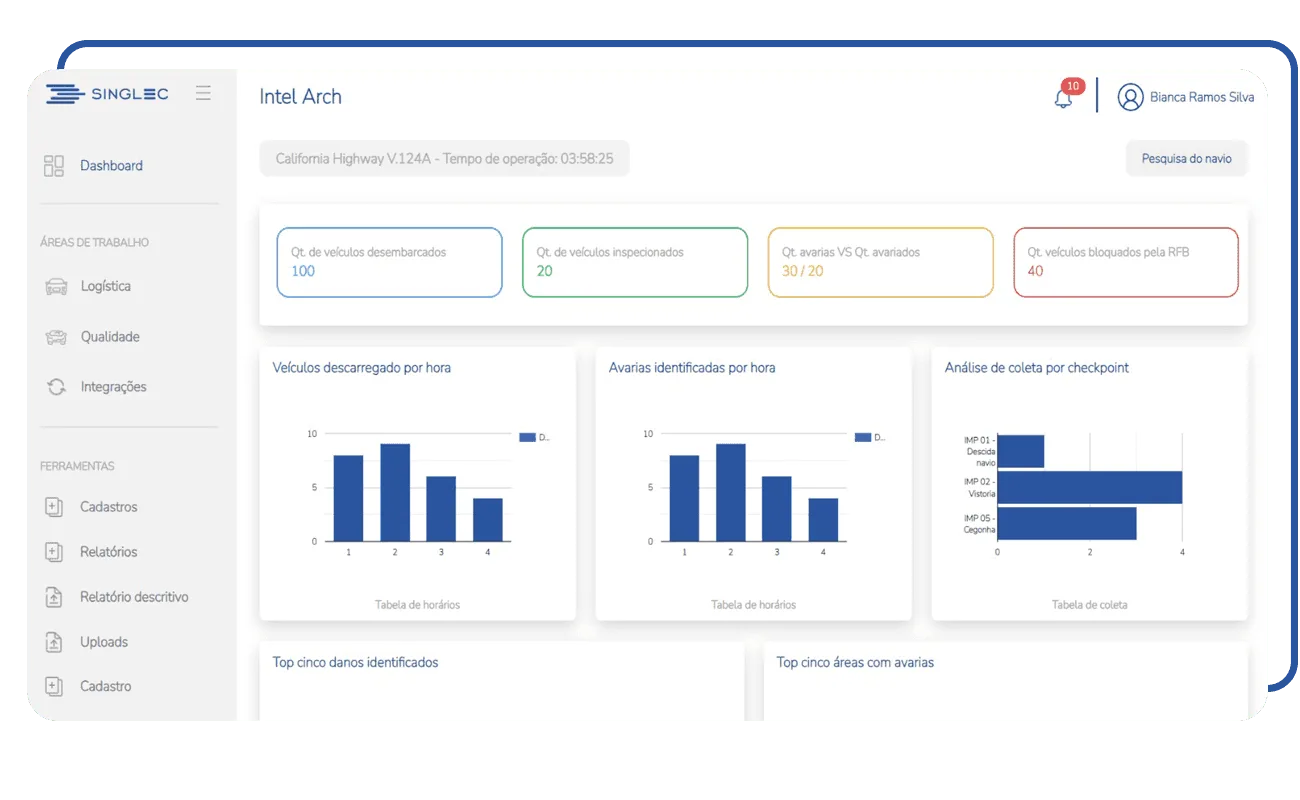
Vehicles discharged, inspected, damaged and held by customs, with the hourly count and the pickup by checkpoint. The terminal's client reads the same dashboard without having to call.
The two main RORO ports in the South, with imports and exports controlled end to end.
Talk to our team and see how YMS Autoport can transform your logistics.
It is Singlec's automotive logistics platform for the Roll-on/Roll-off model. It controls the yard, quality, PDI, loading and distribution over a single vehicle record, from the end of the production line to delivery at the dealer. It has been in operation since 2018 and more than two million vehicles have gone through it.
All rolling cargo: cars, vans, trucks, buses, motorcycles and heavy machinery. Once the chassis is read, the system already knows the manufacturer, model, type, weight and dimensions, and that data decides the slot in the yard, the position on the ship's deck and the place on the truck.
Yes. Events are triggered by the operation itself, filing cargo presence and the bonded area's legal compliance through the customs API, with no parallel data entry. The yard can be bonded or non-bonded.
It does. The checker's app works offline and syncs when the connection comes back. The web portal updates in real time, and both work over the same base.
No. RFID is an optional module, switched on when the operation needs it. When it does, we deliver the whole set: the antenna and portal infrastructure, the tags and the middleware already built into the platform.
No. We build the software that controls both. Our clients are the ones running them, and that distinction matters: every product decision was tested against dust, haste and a weak signal.